IoT & AI

B2C

Competing in the streaming wars without Netflix budgets

Client

British Film Institute (BFI)

British Film Institute (BFI)

Model

Product accelerator

Product accelerator

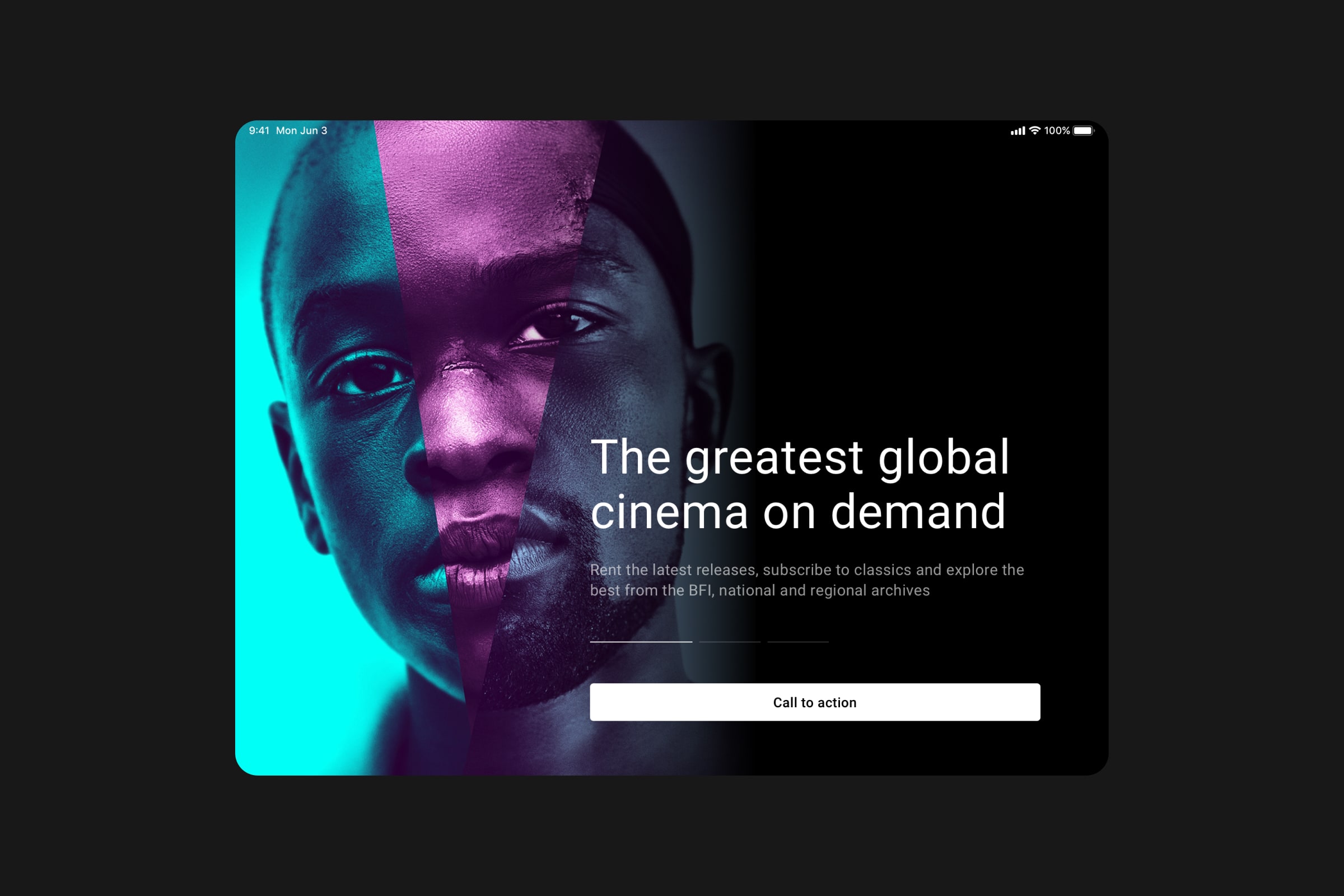
BFI Player onboarding welcome screen on an iPad, featuring a cinematic portrait with teal and purple lighting and the headline "The greatest global cinema on demand."

Services

Product strategy

Product strategy

UX/UI design

UX/UI design

Information architecture

Information architecture

Design system development

Design system development

Rapid prototyping

Rapid prototyping

Info

BFI Player needed to expand beyond web browsers to compete in a streaming market dominated by platforms with billion-pound budgets.

With nearly a third of streaming consumption happening on mobile devices, the absence of native apps severely limited their ability to access audiences 10 times larger than their current reach.

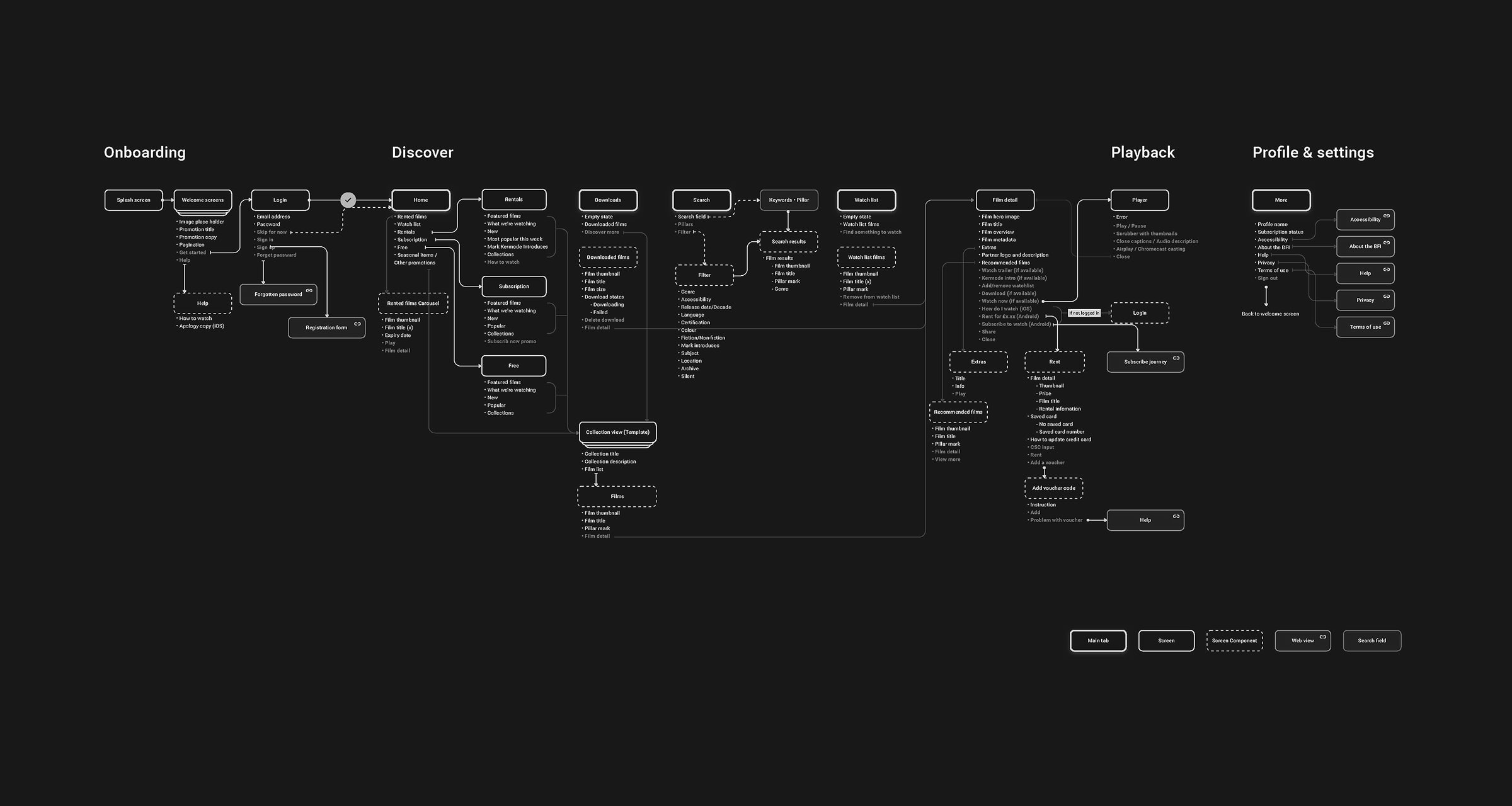
Full information architecture diagram for the BFI Player app, mapping all screens across four sections: onboarding, discover, playback, and profile and settings, shown on a dark background.
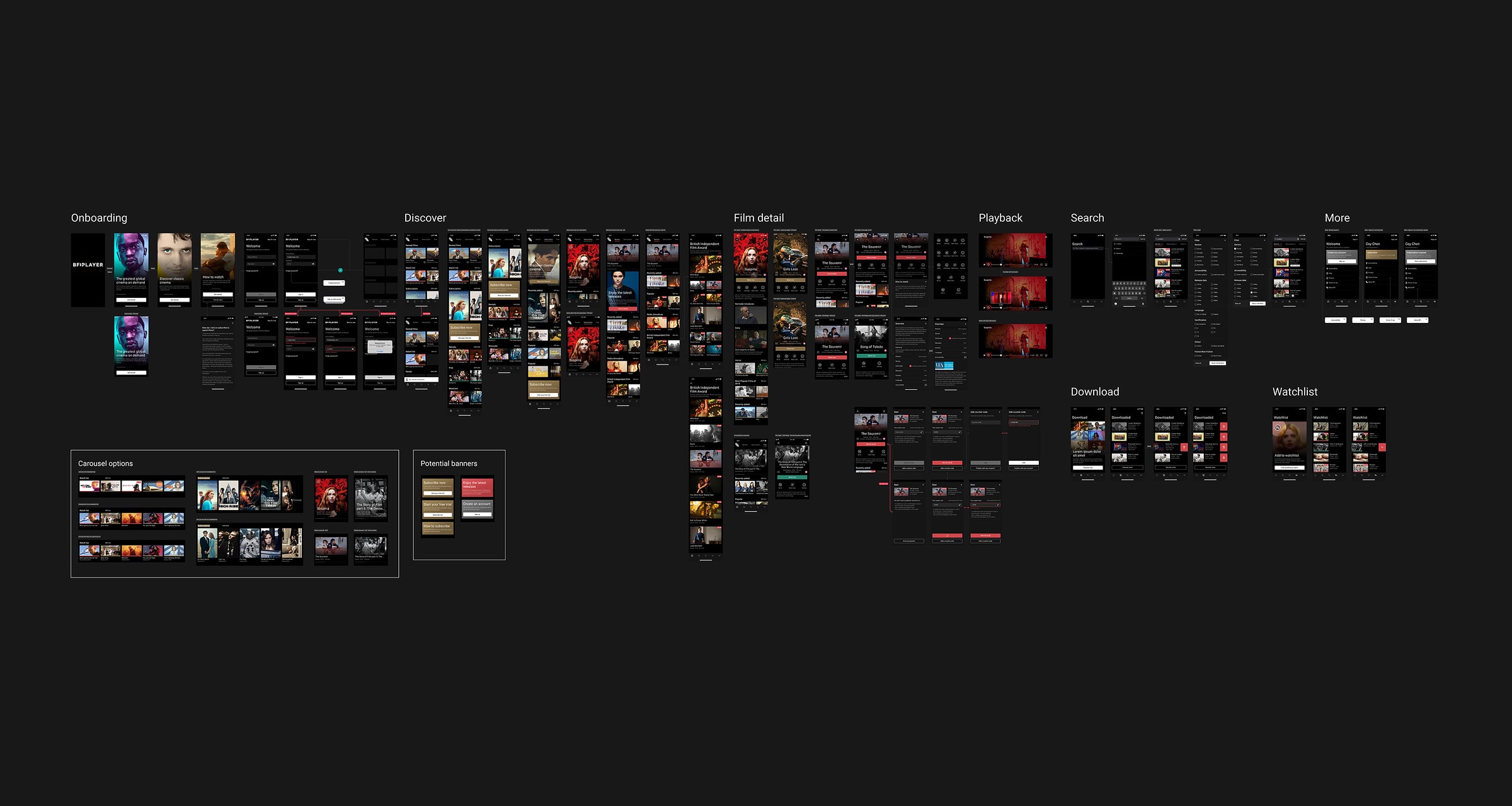
Complete user flow overview in Figma showing all designed screens for the BFI Player app, organised by section including onboarding, discover, film detail, playback, search, download, watchlist, and more.

Challenge

BFI's three business models—streaming, rentals, free archive—required separate user journeys. Mobile users abandon tasks 3x faster when facing friction, threatening conversions. They needed native experiences that could navigate this complexity while competing with Netflix for attention.

Our analysis

Multiple business models meant unlike Netflix's singular approach, BFI could offer flexible pathways to content. Success hinged on designing an information architecture that felt simple while maintaining commercial clarity, treating models as complementary rather than competing.

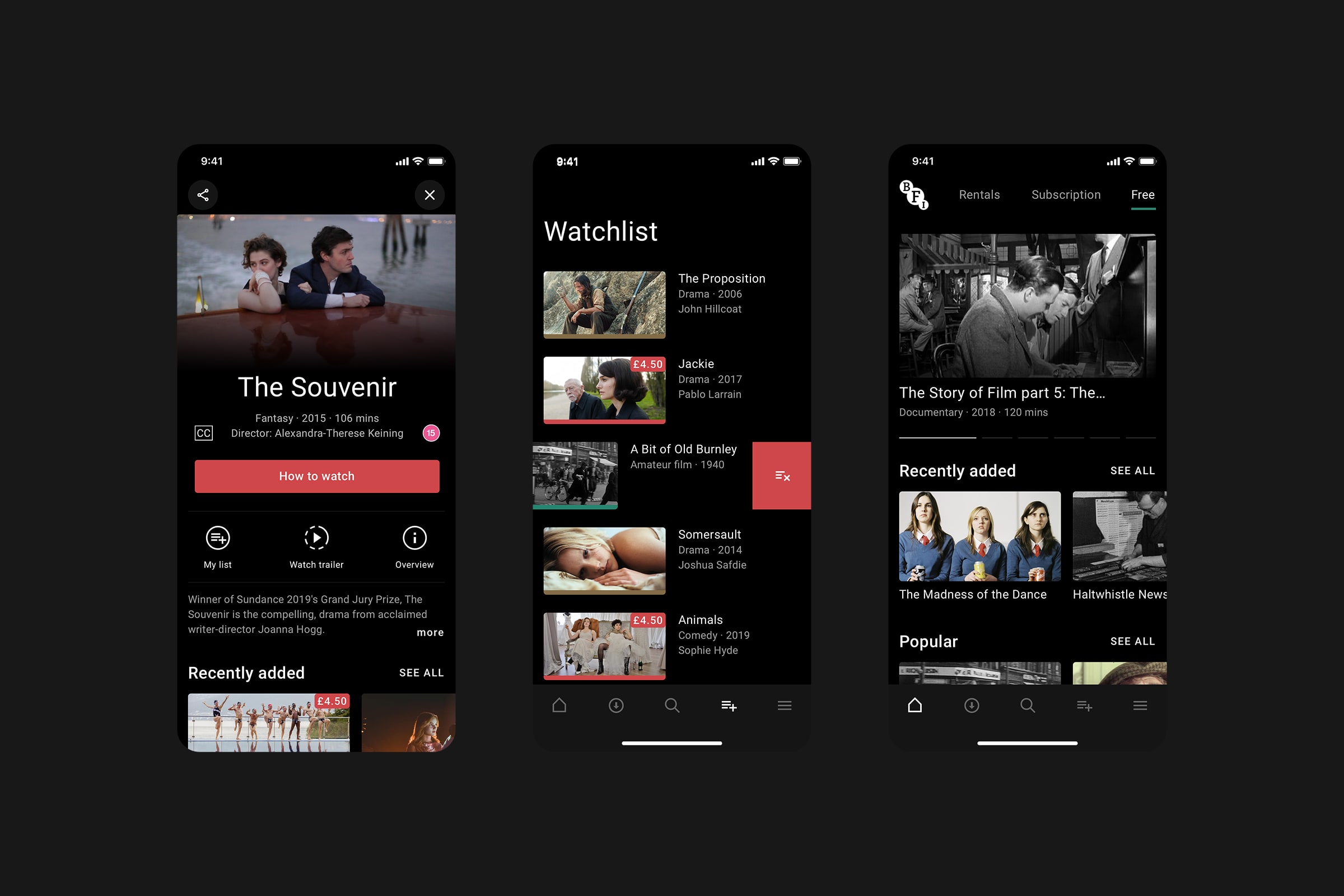
Three mobile screens from the BFI Player app showing a film detail page for The Souvenir, the watchlist view with multiple titles, and the home screen browsing free content.
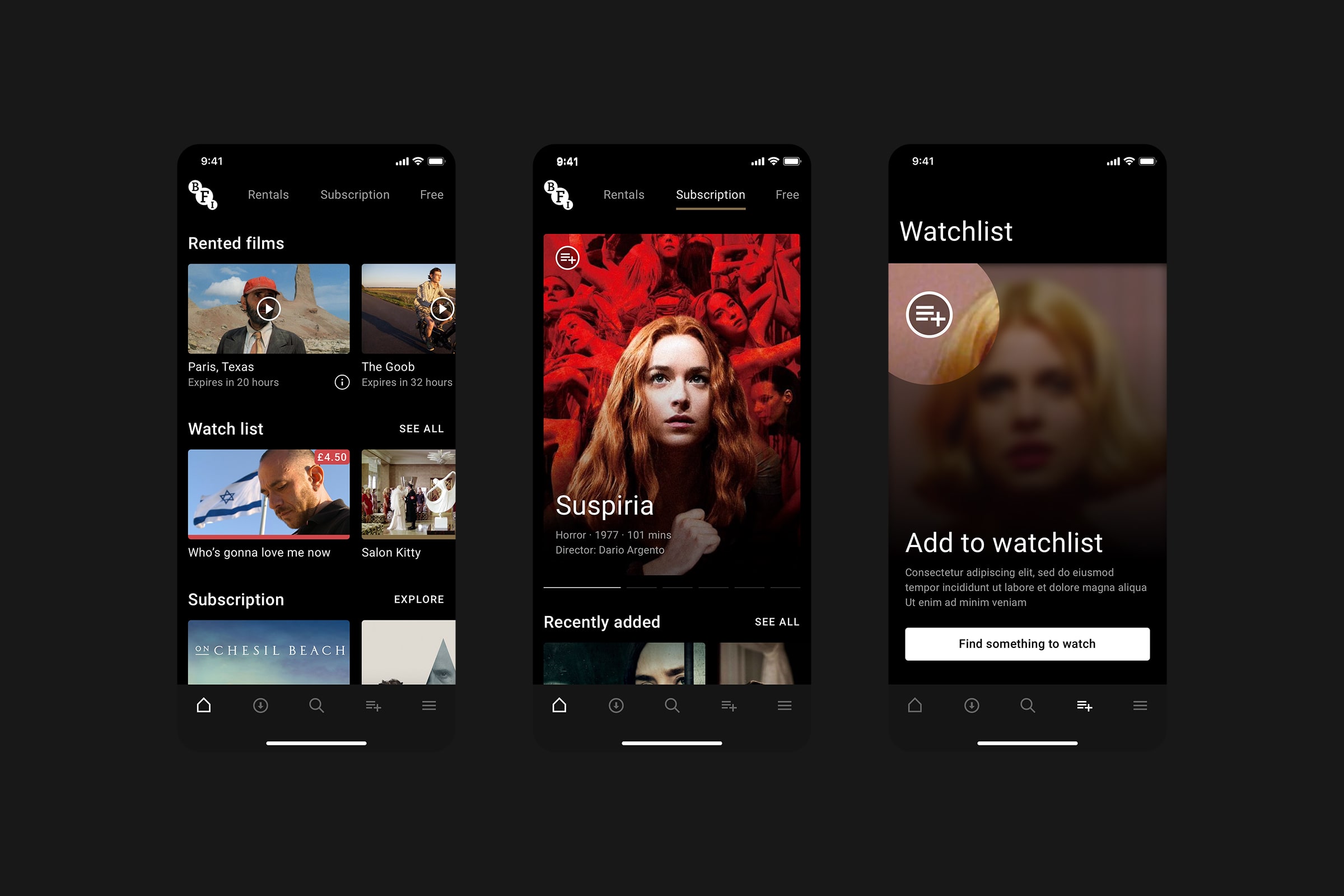
Three mobile screens showing the home screen with rented films and watchlist, a subscription browse page featuring Suspiria, and an empty watchlist state with a prompt to find something to watch.
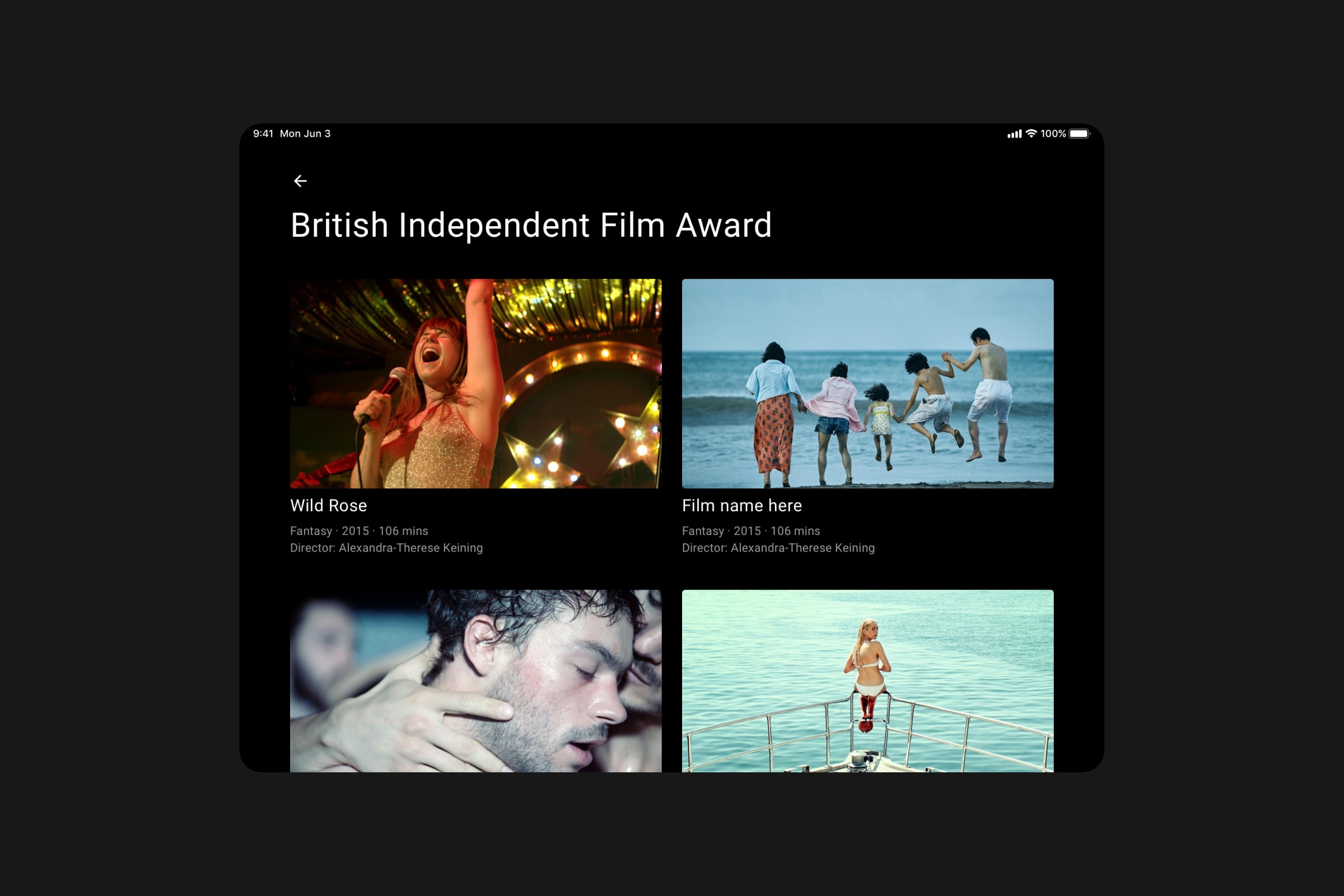
BFI Player collection page displayed on an iPad in landscape, showing the British Independent Film Award category with a grid of four film thumbnails including Wild Rose.
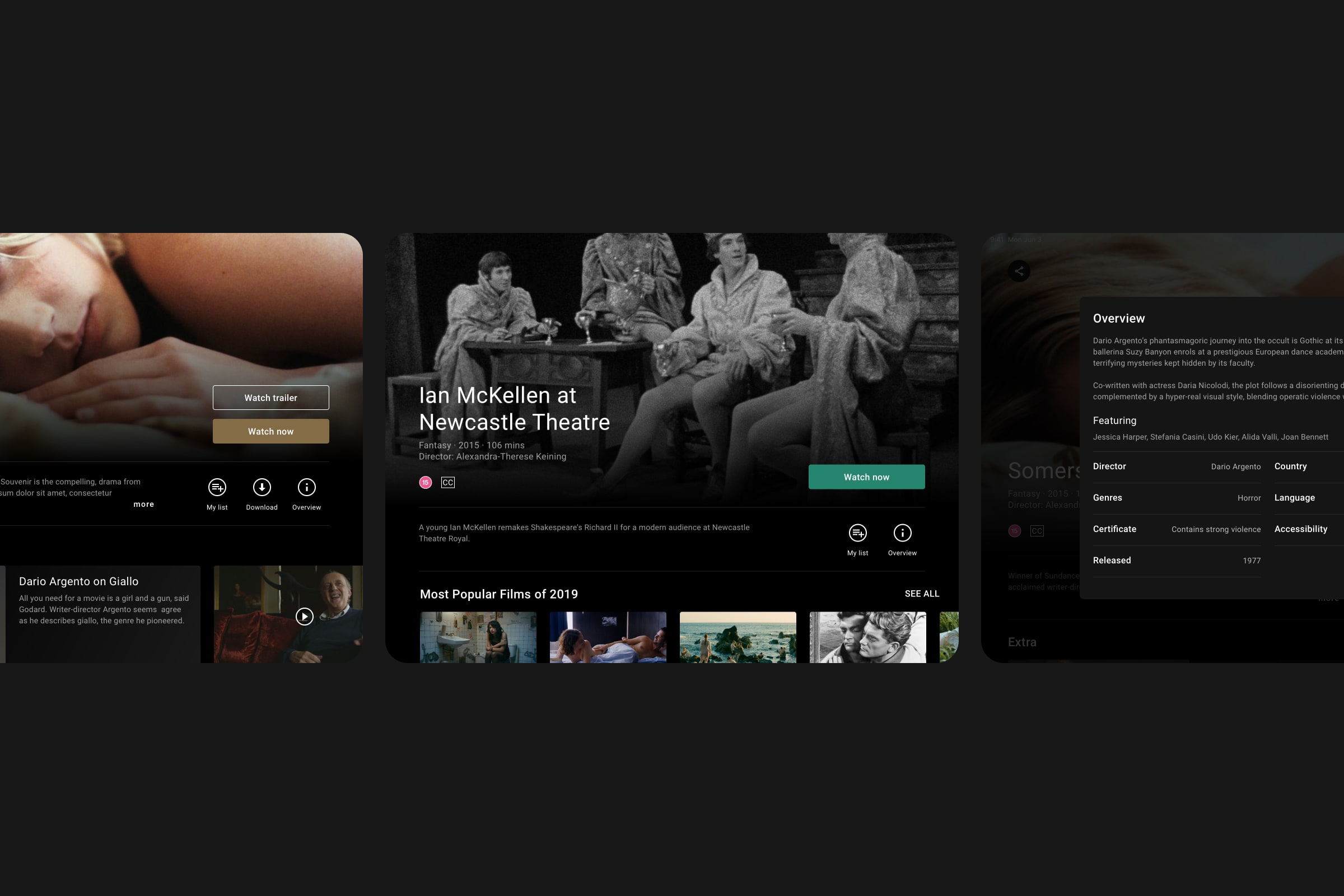
Three overlapping tablet screens showing a film detail page for Ian McKellen at Newcastle Theatre, a side-by-side detail view with film overview metadata, and a partially visible film page with watch options.
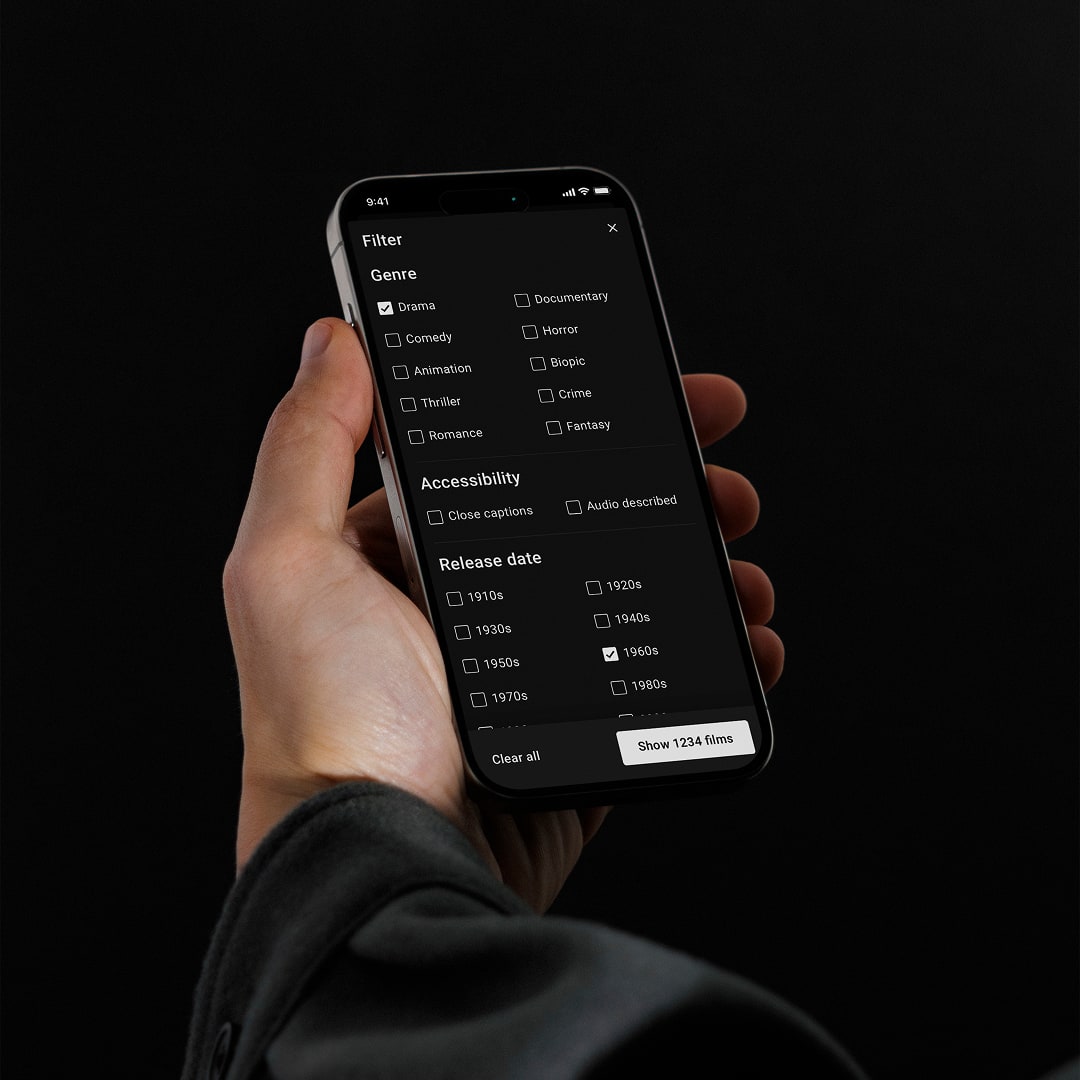
A hand holding an iPhone displaying the BFI Player filter panel, with genre, accessibility, and release decade options, and "Drama" and "1960s" selected.
Close-up of the "Add to watchlist" UI component showing a blurred film still with an add-to-list icon overlaid in the top corner.
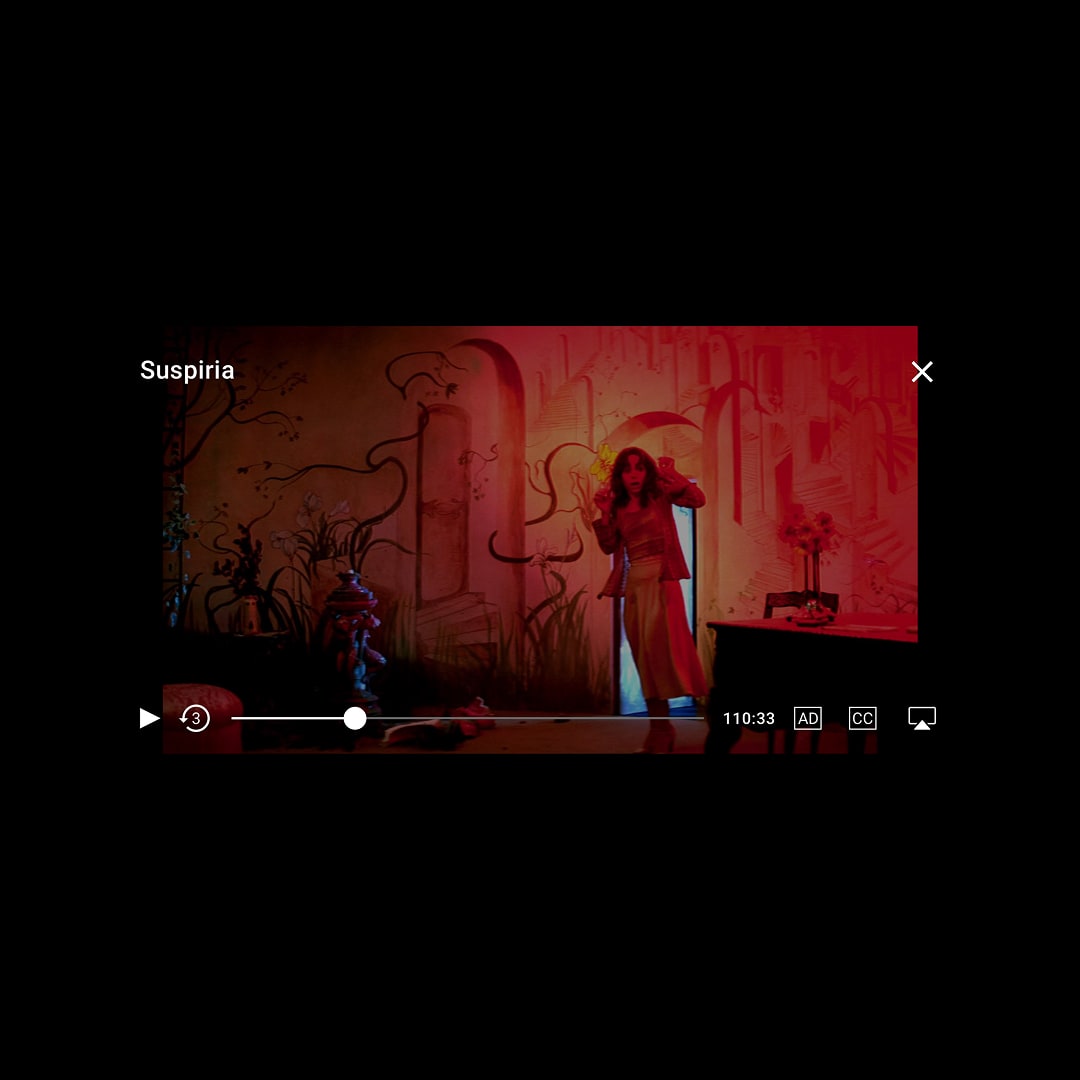
In-app video player showing a scene from Suspiria with playback controls, progress bar, audio description and closed captions toggles, and a runtime of 110:33.
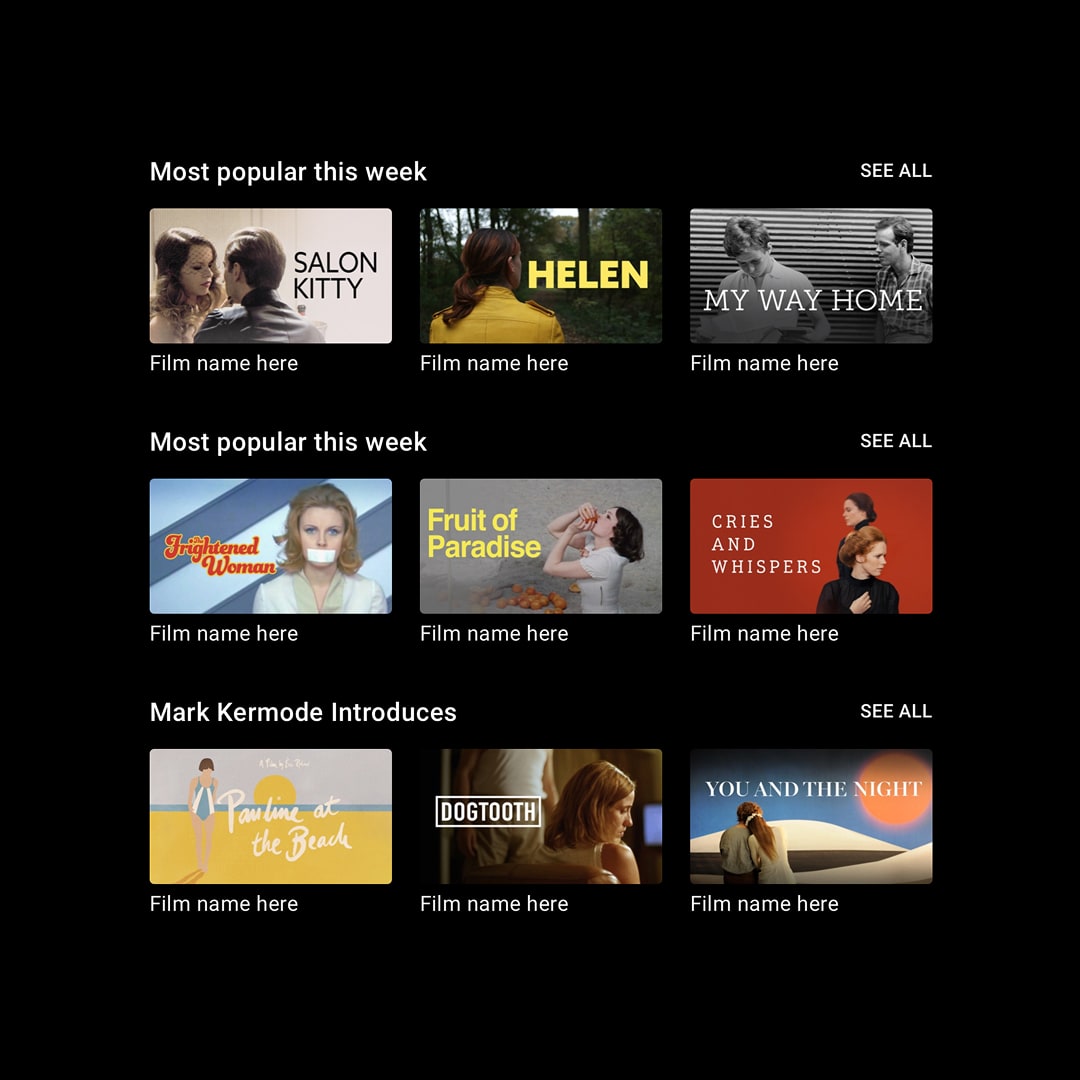
Discovery browse screen showing two "Most popular this week" carousels and a "Mark Kermode Introduces" section, each with three film thumbnails drawn from the BFI archive.

What we did

01.

Unified three business models into one experience

We created browse and search experiences that surfaced all content types together, with clear commercial indicators at point of selection. Users could explore BFI's full catalogue without navigating separate subscription, rental, and free sections.

Unified three business models into one experience

We created browse and search experiences that surfaced all content types together, with clear commercial indicators at point of selection. Users could explore BFI's full catalogue without navigating separate subscription, rental, and free sections.

02.

Built once, deployed everywhere

Native iOS and Android component libraries ensured consistency across phone and tablet formats whilst respecting platform conventions. Component reusability reduces development overhead by 40%, critical given BFI's resource constraints.

Built once, deployed everywhere

Native iOS and Android component libraries ensured consistency across phone and tablet formats whilst respecting platform conventions. Component reusability reduces development overhead by 40%, critical given BFI's resource constraints.

03.

Removed payment barriers

Payment requirements appeared only at point of intent, reducing cognitive load during discovery. Unified watchlists worked across all content types, removing artificial boundaries between business models.

Removed payment barriers

Payment requirements appeared only at point of intent, reducing cognitive load during discovery. Unified watchlists worked across all content types, removing artificial boundaries between business models.

04.

Made checkout frictionless

Platform-specific payment integrations leveraged iOS and Android payment rails at the critical moment. Contextual upsells promoted subscription benefits without interrupting free content users.

Made checkout frictionless

Platform-specific payment integrations leveraged iOS and Android payment rails at the critical moment. Contextual upsells promoted subscription benefits without interrupting free content users.

05.

Achieved platform parity

Working directly with development teams, we ensured technical feasibility across both platforms, enabling faster feature rollout and consistent user experience regardless of device choice.

Achieved platform parity

Working directly with development teams, we ensured technical feasibility across both platforms, enabling faster feature rollout and consistent user experience regardless of device choice.

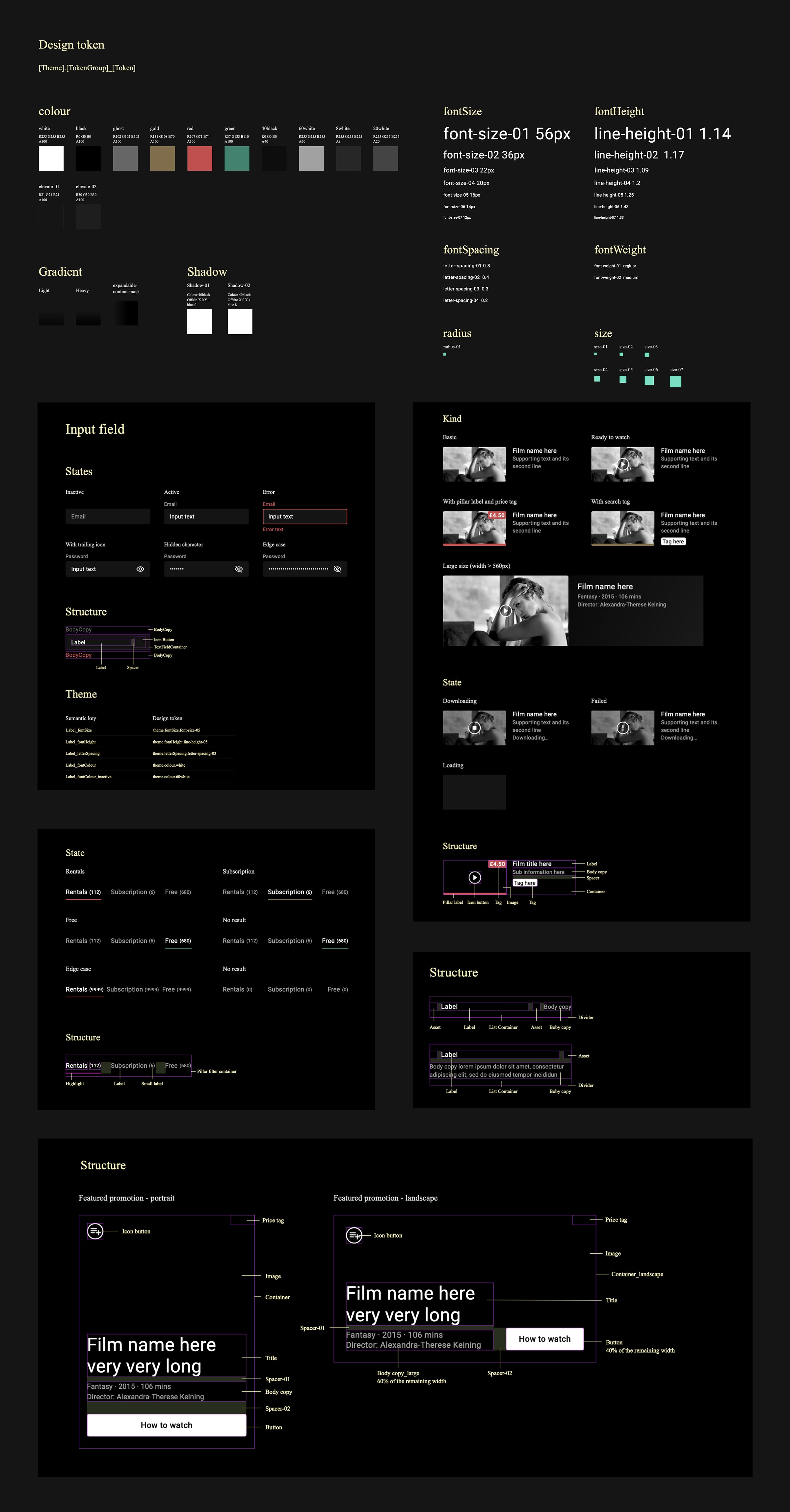
Design token and component documentation page showing the colour palette, typography scale, spacing, radius, shadow values, input field states, film card variants, navigation tab states, and featured promotion layout structures.
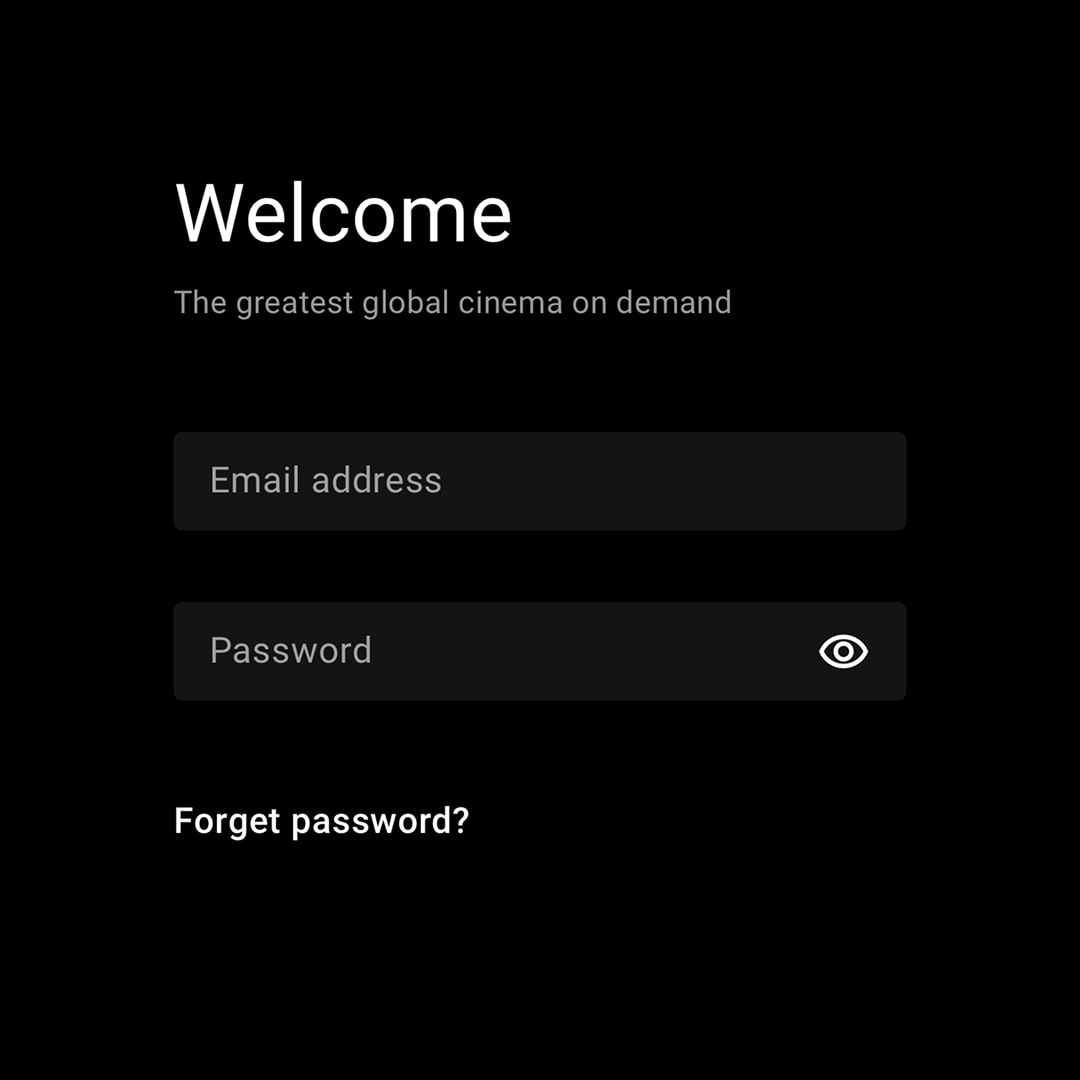
BFI Player sign-in screen on a dark background, showing email and password input fields with a password visibility toggle and a "Forget password?" link.
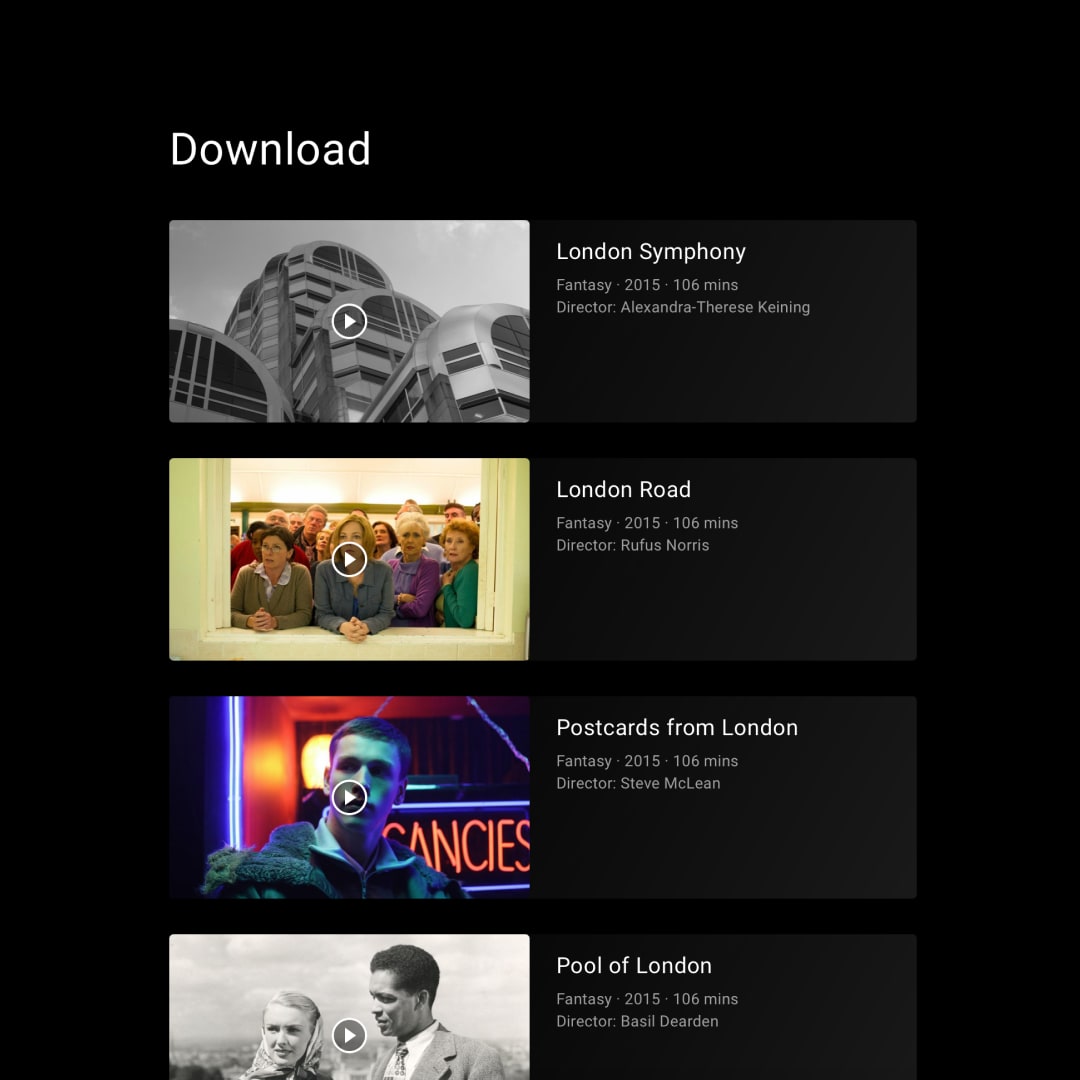
Downloads screen listing four films available for offline viewing: London Symphony, London Road, Postcards from London, and Pool of London, each with a thumbnail and metadata.
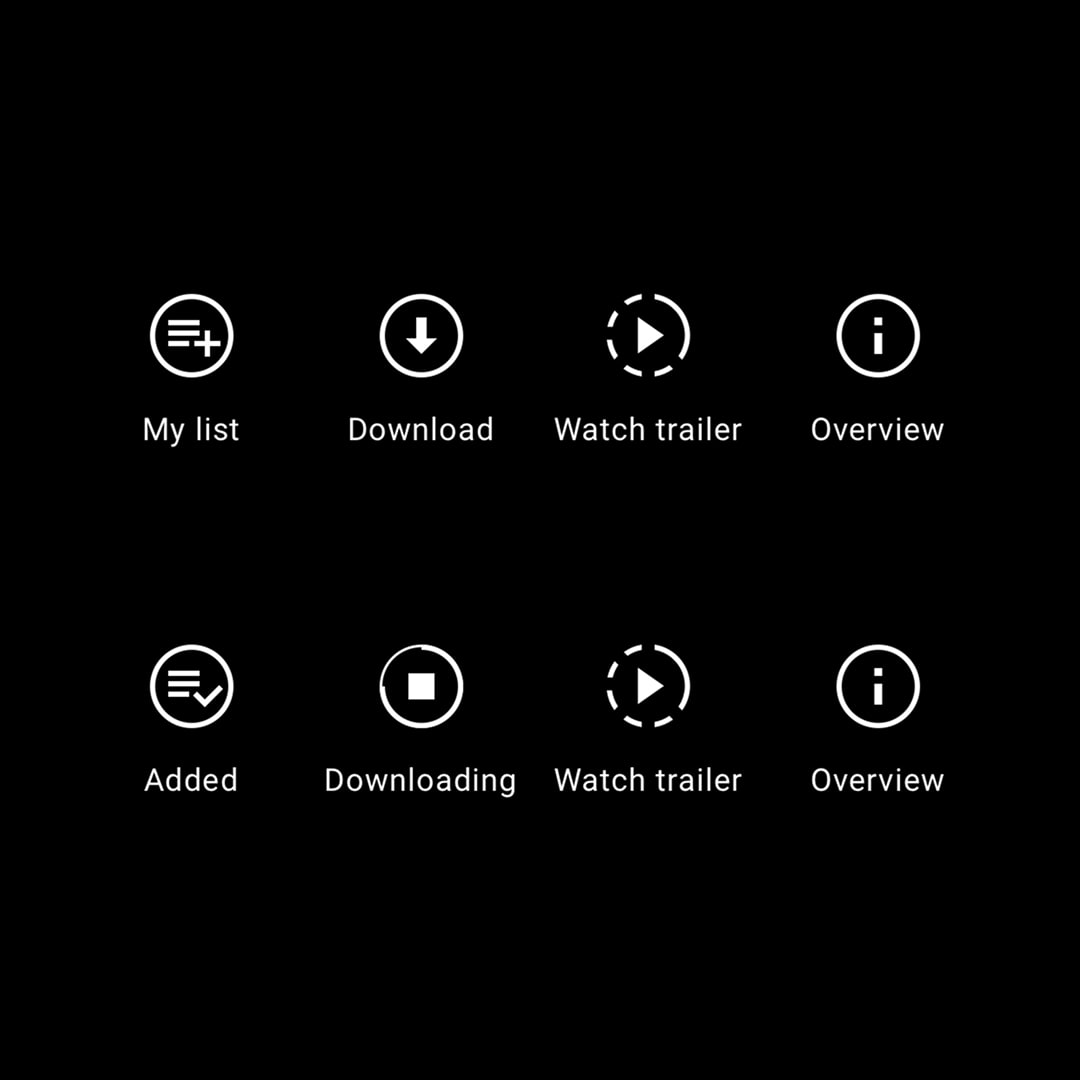
Icon set showing two states for four film detail actions: my list, download, watch trailer, and overview, with default and active variants displayed on a black background.
Profile settings screen showing a subscriber status card with next payment date, followed by menu items for accessibility, help, privacy, terms of use, and about BFI.

Project impact

Expanded addressable market

Mobile applications opened access to the ~30% of streaming that happens on mobile, particularly crucial for reaching younger, diverse audiences.

Expanded addressable market

Mobile applications opened access to the ~30% of streaming that happens on mobile, particularly crucial for reaching younger, diverse audiences.

Reduced development overhead

A unified design system will cut development time by 40%, enabling faster platform evolution within limited budgets.

Reduced development overhead

A unified design system will cut development time by 40%, enabling faster platform evolution within limited budgets.

Enabled platform transformation

Mobile expansion provided immediate market presence whilst longer-term digital transformation progressed.

Enabled platform transformation

Mobile expansion provided immediate market presence whilst longer-term digital transformation progressed.

Digital transformation demands strategic design, not just more channels

Ambitious companies face a familiar challenge: competing against tech giants with unlimited budgets whilst managing multiple business models and legacy constraints.

Success requires more than adding digital channels: it demands design that transforms operational complexity into competitive advantage.

We specialise in accelerating digital transformation for organisations where failure isn't an option. Our evidence-based approach identifies the critical design decisions that unlock growth without requiring Silicon Valley resources.

Ready to transform your digital platform strategy? Let's discuss how strategic design can enable sustainable competitive advantage.